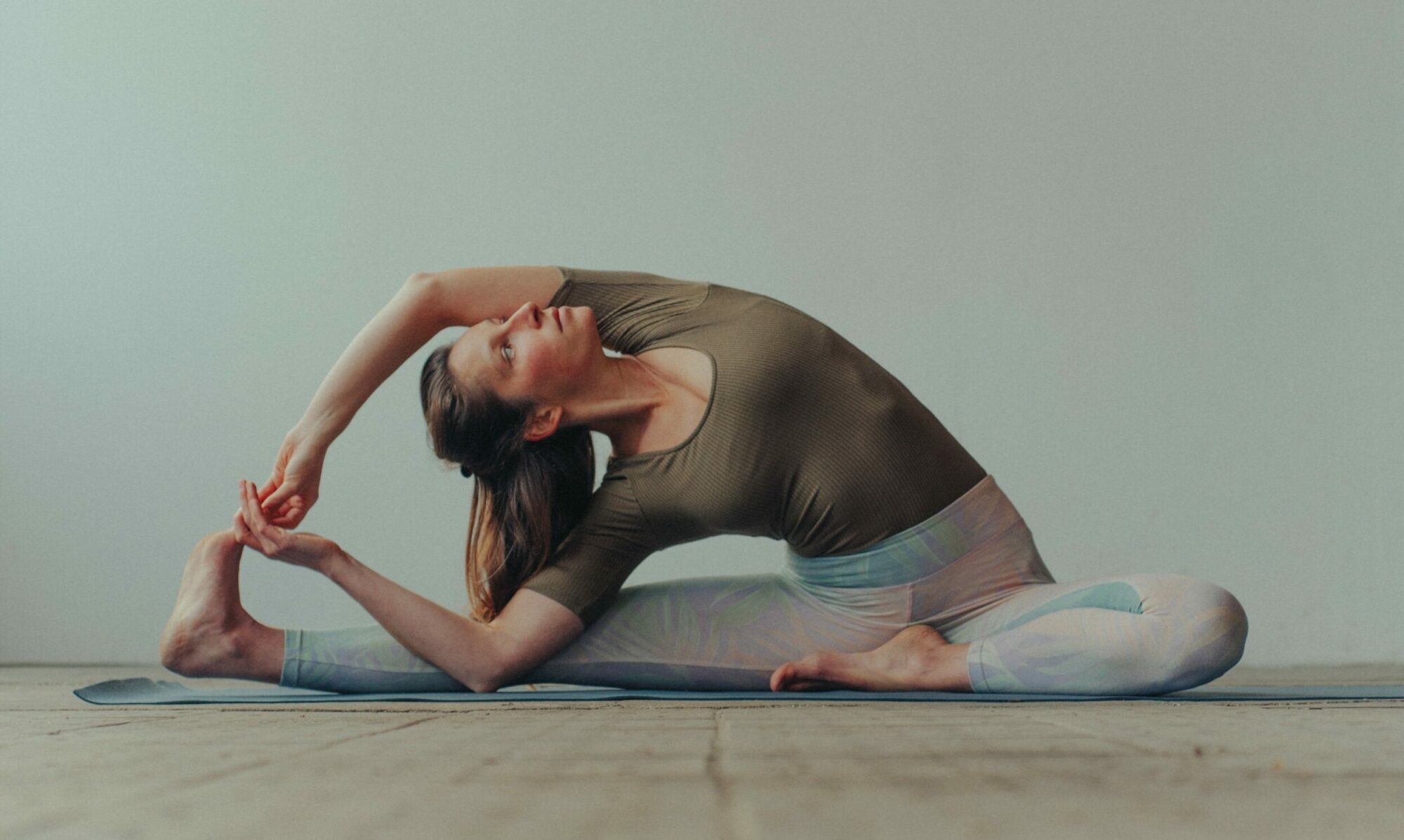
Presence (1) in the sense of consciously perceived presence is a desirable state of consciousness for many people, as it generally leads to calmness, inwardness and contentment. There are many approaches and ways in which presence can be developed and it is also understood in different ways.
When we think of presence in the sense of being present with inwardness and calm, especially without being emotionally or mentally driven, we generally think of silent retreats, Zen meditation or Vipassana, insight meditation or Jon Kabat-Zinn, who made the well-known presence training of mindfulness-based stress reduction socially acceptable.
Different approaches in the practice of asana
How can the experience of presence be developed in the practice of yoga exercises, in an āsana? How does consciousness participate in movement? There are certainly different approaches here too.
The body scan, the inner scanning of the body, is a well-known method in the field of relaxation that is also widely used in the physical exercises of yoga. (2) Sensing during and after the performance of an exercise are common methods for achieving peace and integrity with the body. This feeling into the body can also be described as an immersion of the consciousness into the body and thus into its own emotional-subjective world, which can be experienced as very pleasant.
A second, diametrically opposed possibility is to emerge from one’s own subjective inner world into an objective perception. Objectivity in the sense that the perception of the body is not a subjective reality, but that the body is elevated to an object, a counterpart. Consciousness confronts the body here and remains consciously distanced.
Increasing your presence in the New Yoga Will
What practical steps are necessary to intensify or increase presence in a yoga exercise? Heinz Grill mentions various phases that are completed in awareness during the practice. (3)
The five practical steps for developing increased presence are:
1. Calm down
2. Let go
3. Perceive the actual state
4. Imagine your ideal state
5. Putting it into practice
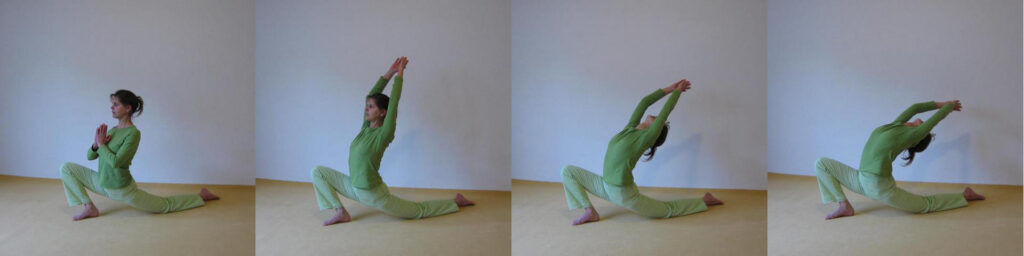
At first, you simply enter into an āsana, for example half moon, and become still in the first step. Coming to rest means that the body becomes motionless and transitions into stillness, without any motor activity. The breath is left to its natural flow. The consciousness now becomes more active and adopts an observational stance towards the body.
The second step is to let go of the body a little. This letting go relates to the nervous tension and muscles, but even more so to the emotions that accompany the physical condition. Perhaps you would rather leave the position straight away or feel driven to go further into it?
Letting go can be almost imperceptible, but an outside observer will notice that the body appears less dominant, less intrusive. He backs away a little.
On this basis, the actual state can be realized in the third step . What is the stress distribution like? Is it where it should be? Which areas can still be relaxed? What is the dynamic, the support, the stability? What is the overall shape? Am I staying below my capabilities?
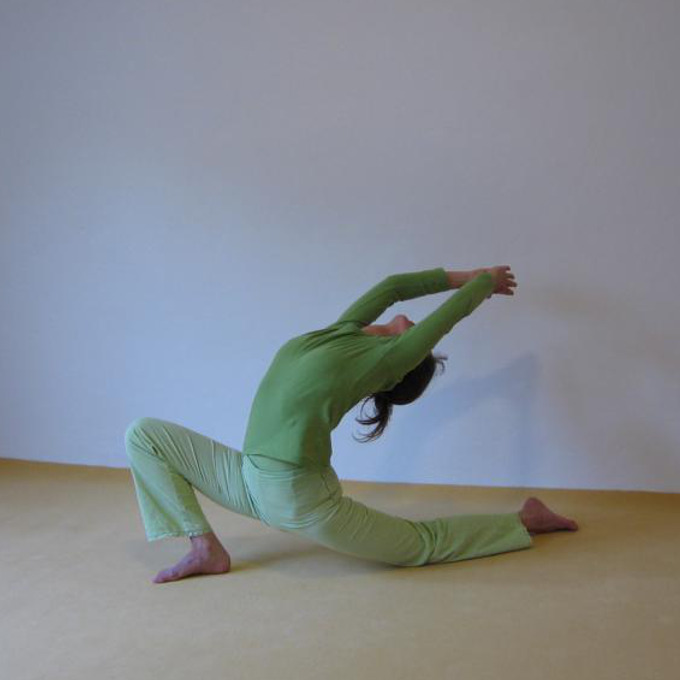
In the fourth step , an ideal of the position is conceived. The next possibilities and steps for the further development of the movement are presented. This can be a greater range of movement or relate to more ideal tension ratios. As knowledge increases, the characteristic properties of the various chakras and mental and spiritual symbols of the āsana are included, as is typical in the New Yoga Will . In the crescent moon, this would be the sinking of the hips and legs towards the ground of the earth with the simultaneous sliding of the upper body out into cosmic space. The practitioner experiences that these directions of movement support each other. The more the sinking in is successful, the easier it is for the upper body to move outwards and vice versa.
The observer will also be able to perceive this alert activity in the consciousness when the practitioner realizes the actual state and especially when he recreates the ideal state and transfers it to the body. In these phases, the presence of the practitioner’s consciousness can be perceived very well. You can almost observe how the consciousness is actively engaged in its thinking and observing activity and also actively relates to the body.
Finally, in the fifth step , the body is led further into the movement according to this new idea. The content that was introduced is now increasingly expressed in it. Interestingly, the position is perceived as easier despite the advanced execution. The body follows the idea that was created from the consciousness.
The 5 phases can now be repeated several times in succession. It is amazing how the body can overcome its own resistance and how the movement in āsana can be developed further and further.
The first three steps are generally known and are practiced in one way or another in many different yoga styles. From the fourth point onwards, the demands on awareness increase considerably and require an intense presence towards the content and the physical conditions, which Heinz Grill describes as an increase in presence.
But what is a heightened presence? It is dwelling in an ideal and thus in a spiritual reality that is newly created in addition to the general actual state. The spiritual reality now finds its way into the practice of physical exercises. It expresses itself in all its beauty and aesthetics.
Everyone can determine the extent of the dispute themselves.
by Angelika
(1) Präsenz: Digitales Wörterbuch der deutschen Sprache, Retrieved on February 9, 2026.
(2) Bodyscan: Buddha Foundation, Retrieved on February 9, 2026.
(3) Quote from Heinz Grill, Study Days at the Lundo Free Spiritual College on the topic of presence on September 3-4, 2025.
See also: The 5th chakra develops through clear and guided awareness activity Retrieved on February 9, 2026.
Further links:
A detailed description of the guidance of the body from consciousness can be found in the article: Logic and Laws of Health XIX – The Activation of Cellular Respiration and Cellular Transillumination from March 13, 2025. Retrieved February 9, 2026.
Aurora Wiki: Presence. Retrieved February 9, 2026.
Bildquellen
- Halbmond-Serie Angelika Liefke: privat | All Rights Reserved


